
Teen birthday party ideas for 13 to 16 year olds
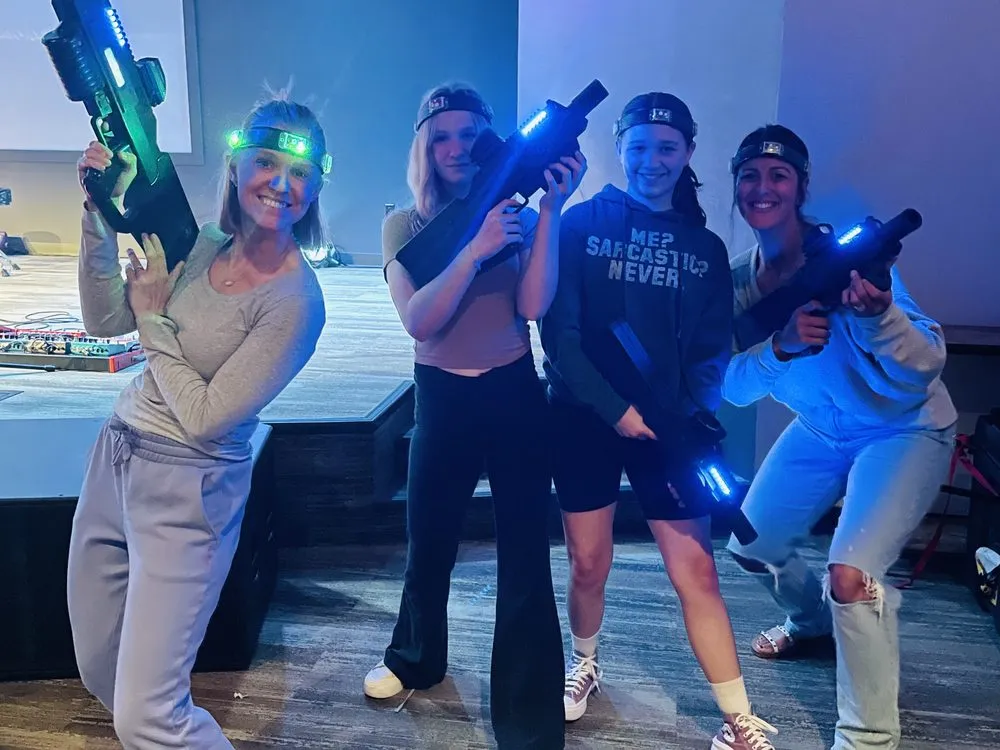
Teen birthday party ideas hold 13 to 16 year olds when the activity is competitive, team-based, and run by an adult who is not their parent. Hosted laser tag, a game truck, or VR puts the whole group in the same game at once for two hours, which is what stops a teen party from drifting to the couch.
"We rented their laser tag setup for our teen event, and everything went smoothly from start to finish." That is Emily Dewey in St. Louis, and the word worth holding onto is teen. Parents expect a teenager's party to be harder to run than a nine year old's, and the planning around it is harder, because the guest list has opinions and rides and a group chat. The two hours in the middle are the same two hours, as long as somebody else is running them.
What changes between ten and fourteen
A fifth grader gets dropped off and plays whatever is in front of them. A fourteen year old arrives in a staggered wave across twenty minutes, already knows who else is coming, and decides early on whether this is worth staying at. Nobody announces that decision, you just watch it land, and the visible form it takes is phones.
Phones are the symptom rather than the cause. Teens reach for them in the gap between activities, not during one, so the party that keeps them in pockets is the party that never opens a gap. Three things open gaps at this age, and none of them is the theme.
- A start that waits on stragglers. If the first half hour is spent standing in a kitchen waiting on the last two kids, the room has already broken into small clusters and screens, and pulling it back together takes real work.
- A parent running the games. Teenagers will do almost anything for an adult who is not related to them, and almost nothing for the one who reminds them about homework. That is not personal and it is consistent enough to plan around.
- An activity with no result. Hanging out is what they do every weekend for free. A birthday needs a scoreboard, a winner, and an argument about a call in round three.
The other shift is that you are no longer the audience. At ten, a party gets judged on whether it stalls, and at fourteen it gets judged on whether it was worth the Saturday, by people who will say so out loud on Monday.
The three tests a teen party has to pass
A birthday party for a teenager works when it passes three tests: the activity produces a winner, a host who is not the parent runs it, and it ends at a stated time instead of drifting. Run the usual list of ideas through those three and most of it falls at the first one.
It produces a winner. Teams, rounds, and a score give a group of teenagers something to talk about that is not each other, and that is the whole mechanism. It is why competitive formats hold this age when a craft table or a movie will not.
A host runs it. Hosted means a named Event Manager arrives about an hour early, builds the setup, explains the modes, referees every round, keeps the rotation moving, and packs the whole thing out at the end. A drop-off rental means the gear arrives and you become the referee, the scorekeeper, and the person troubleshooting a dead battery in front of sixteen teenagers. Those are two different products at similar prices, and the difference shows up in your evening rather than on the invoice.
It ends. A stated finish on the invitation does more work than any other planning decision you make, because a ragged start already pushes the back end, and a party with a soft ending turns into six kids waiting on rides in your living room at eleven.
What to book, by age and by space
Everything below comes to you fully staffed, so the yard, driveway, or hall you already have matters more than any venue. The birthday setups run at a house, a park pavilion, or a church gym, and the three main formats sit side by side here if you want them compared directly.
- 13 and 14, with a yard, a park, or a gym. Laser tag is the strongest fit for this age and the one teens ask for again. Nature's Field is $329 for two hosted hours with 10 tagger and headset kits, covering a group of up to 20 in team rounds. The Quick Up Field at $429 adds pop-up blinds for cover, and the Premium Field at $529 builds a full red versus blue battlefield out of weighted inflatable barriers. Taggers reach up to 600 feet and the game plays indoors or outdoors, day or night. Extra taggers past the 10 kits are $20 each, and another 30 minutes is $100.
- 13 and 14, when the whole friend group games. The game truck Classic is $449 for two hours and up to 20 guests across 7 stations on PS5, Xbox, and Switch. It is climate-controlled and runs on its own generator, so a November birthday is not a weather bet, and it parks in about 55 feet of flat space. The Hero Party at $649 adds a virtual reality station, a racing wheel and pedals, a red-carpet walk, and a ninja dog tag, and it is the tier listed as popular for ages 11 and up. "my son who was celebrating his bar mitzvah said this was the best night ever." That is Mindy Woolf, about a thirteen year old's night.
- 15 and 16, indoors. Worth being straight about the ceiling here. The game truck's stated range is ages 8 to 15, so for a group of high school sophomores laser tag and virtual reality are the better calls. VR is $450 for 60 minutes on four Meta Quest 3 headsets with a host the whole time, or $550 for 120 minutes with themed experiences like Walkabout Golf and escape rooms. It needs a large climate-controlled indoor room, and four play at once, so past eight guests it works as one half of the night rather than the whole of it.
- An evening indoors. The game arena is a pop-up console lounge built inside your building, $500 for two hosted hours or $750 for the Pro tier with 7 gaming stations and LED tower lighting, for up to 20 players. When a teen party has to fill a gym or a finished basement from six to eleven, add hours at $100 each to cover the whole window.
How many teens play at the same time
Ask a vendor how many play at once, not how many the package covers. Those are two different numbers, and the second one is the number on the website.
Laser tag ships with 10 tagger and headset kits, so ten are on the field in a given round and a group of twenty plays in rotating teams, which suits the format, because rounds end and teams reshuffle anyway. Add taggers at $20 each when you want sixteen of them out there at once. The game truck runs 7 stations, so seven are in a game while the host keeps every seat full and up to 20 cycle through. VR is four headsets with four players competing in real time. RC racing is a different shape again, a custom track for up to 16 racers, and it is the one option on this list with no screen in it.
Past twenty guests, one attraction becomes a line, and a line is exactly the gap where phones come back out. That is the point where a second attraction earns its price, and the usual pairing for a teen crowd is laser tag outside with the truck or the arena inside.
A timeline that survives a ragged start
- An hour before. Your host arrives and builds the field or sets up the truck. Nothing is asked of you except the space.
- The first fifteen minutes. Guests trickle in. Put the food here rather than at the end, because it gives the early arrivals something to do and it does not need everybody present to work.
- Minute fifteen. The host gears everyone up, walks through the modes, and splits the group into teams. Latecomers fold into the next round without stopping anything, which is the practical reason a hosted format beats a printed schedule at this age.
- Minutes fifteen through seventy. Rounds, scores, and rematches, and the stretch where you are watching instead of managing.
- Around minute seventy. Cake, then straight back out. Saving it for the end sends everyone to their phones to text for rides twenty minutes early.
- The last twenty-five minutes. Final rounds, a winner, then the host tears down and pulls out while the group is still arguing about the last one.
Evening is the upgrade this age group notices. Laser tag plays after dark with the taggers and headbands lit up, so a 7pm start in October gives you an hour of daylight and an hour that feels like a different game, at the same price.
What it costs and what holds the date
Starting prices are $329 for laser tag, $449 for the two-hour game truck Classic, $450 for virtual reality, and $500 for an indoor game arena, and each of them sits on the pricing page next to what it includes. A $100 deposit holds your date. Travel is free within 29 miles of Granite City, and 30 to 39 miles adds a flat $40, which you hear before you book rather than after.
Teen birthdays land on Friday and Saturday evenings, and those two slots go first in a fall calendar where school events and church festivals are booking the same weekends. Six to eight weeks out is comfortable. Two weeks out is still worth a text to (618) 845-7171, because dates open up when other plans move.
What you are buying
"Us adults even joined in for some fun on laser tag." That is Kim Dondanville, and it points at something parents of teenagers stop expecting, which is being welcome in the middle of it. A hosted party puts a named adult in charge who is not you, and it gives you back the part of your kid's birthday you used to have when they were seven, standing at the edge of your own yard watching them with their friends. Send us the date and the headcount and we will tell you which setup fits your space and how many of them can play at once.