
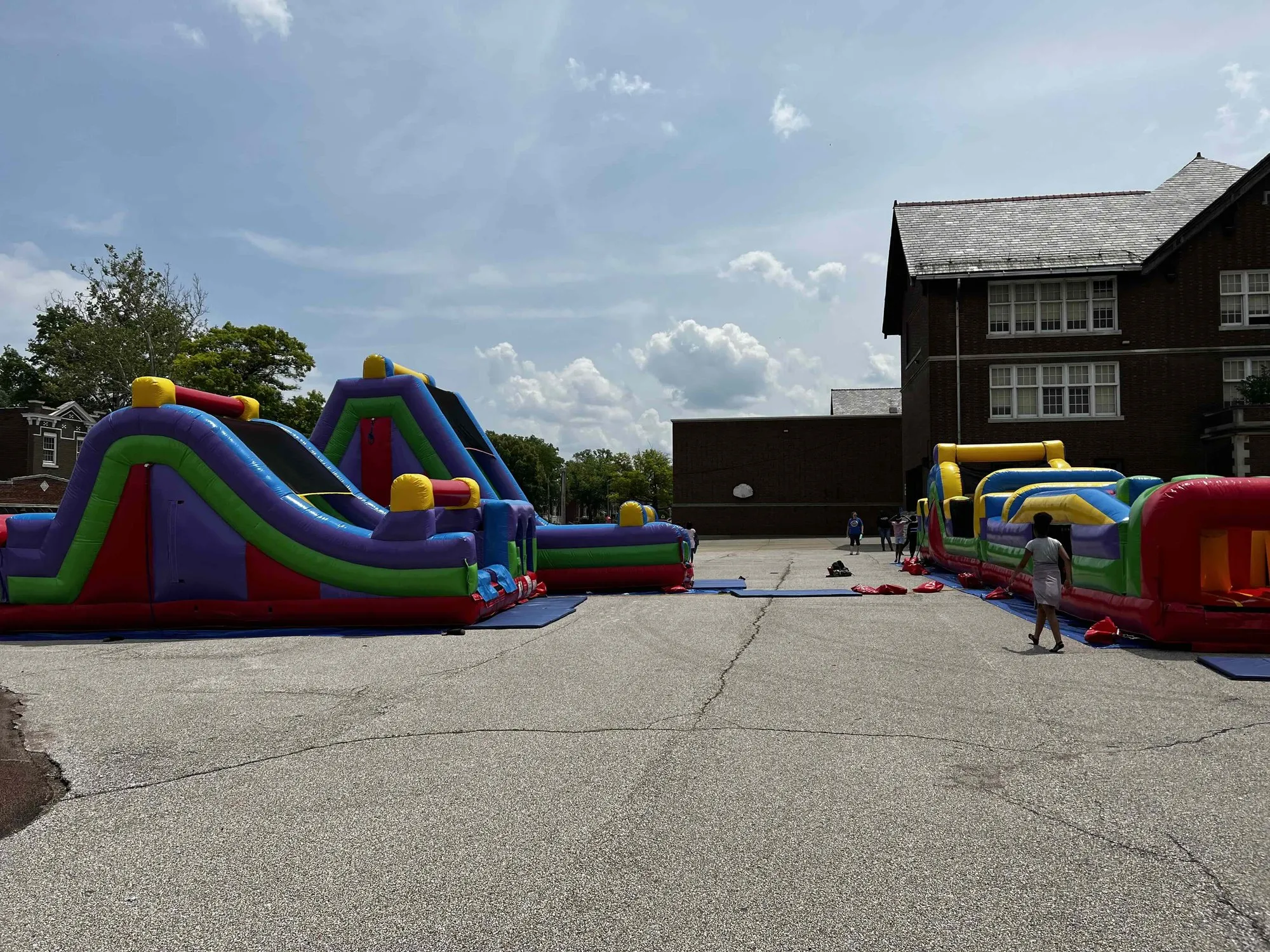
How many inflatables do you need for a school field day?
Plan a field day in students per hour, not in units. A two-lane obstacle course moves a line far faster than a bounce house, because two students race, finish in under a minute, and the next two go, while a bounce house holds three at a time and they stay in. As a rough guide, 150 students needs about two units, 300 needs three or four with at least two of them courses, and 600 needs a rotation schedule rather than more inflatables. The paperwork matters as much as the count: Illinois districts commonly ask for a certificate of insurance naming the district and proof the units are state inspected.
Count turns, not units
The mistake most field day committees make is counting inflatables. What actually decides whether the day works is how many student turns your setup produces per hour.
Start with three numbers: how many students, how many hours, and how many stations you want each student to hit. Most elementary field days run two to three hours and aim for three or four rotations per student. Multiply, divide by the hours, and you have the throughput you need to buy.
Why the bounce house is the slow one
This is the part that surprises people. A bounce house sounds like the high-capacity option and it is the low one. Ours hold three at a time, which is typical for a 13x13 unit, and once kids are in they stay in until someone makes them come out. That is fine at a birthday party and it is a bottleneck at a field day.
An obstacle course runs two at a time, because it is built as a two-lane race. Fewer bodies on it at once, far more turns per hour, and the line polices itself because everyone can see whose go it is next. For a crowd, courses move people and bouncers hold them.
Worked examples
About 150 students, two hours
Two units is usually enough. One 30-foot two-lane obstacle course as the main mover, plus one bounce house for the youngest grades or one interactive game. If your grades skew older, swap the bouncer for Human Foosball or the sport games.
About 300 students, two to three hours
Three or four units, and at least two of them should be courses rather than bouncers. A common build is one long course, one 30-foot course, one bounce house for K through 2, and one interactive game like Soccer Darts or the Interactive Play Cones that runs fast and needs almost no supervision.
About 600 students
At this size the answer is not more inflatables, it is a schedule. Bring classes through in timed blocks rather than opening everything to everyone, and put an adult at each station with a stopwatch. Four to six stations with a real rotation beats eight stations with a free-for-all, every time.
What grades 5 and up will actually use
Fifth graders and up walk past a bounce house. If it looks like something a five-year-old would love, the seventh graders will avoid it, and you will have paid for a unit nobody used.
What works for older students: obstacle courses, the 40-foot rock climb slide, Human Foosball, the dual lane axe throw, and the sport inflatables. All of them read as competition rather than as play equipment, which is the whole difference. This is also the list to use for post-prom, where the crowd is seventeen and eighteen year olds and a bounce house is a non-starter.
The paperwork that decides whether a vendor can come at all
Two questions gate this in Illinois, and most vendor websites answer neither.
Certificate of insurance. Most districts require a COI naming the school or the district as additionally insured before a vendor sets foot on campus, and some specify minimum coverage. Ask for it when you request the quote, not after you have chosen. We carry general liability in both Illinois and Missouri and the certificate comes back with the quote when you ask.
State inspection. Our inflatables are inspected by the State of Illinois. If your district asks for proof of inspection, we have it. It is worth asking every vendor you are considering, because very few in this market say anything about it publicly.
Worth asking about too: whether the crew is background checked, whether the company takes a purchase order, and whether they need a deposit. Schools do not pay a deposit with us. A signature holds the date, or a PO if the district requires one, and check payments have no fee.
The rain plan
Field day rain plans are hard, and the honest answer is that some units move indoors and some do not. Obstacle courses and the interactive sport games often fit in a gym, and ceiling clearance is the thing to check rather than floor space. Water slides and the taller units do not go inside. On a gym floor we anchor with sandbags instead of stakes, so say so when you book.