
School Fall Carnival Ideas Your PTO Can Staff
A school fall carnival holds together when the station list is built from the volunteer roster instead of the wish list. Count confirmed parents, split the night into 45-minute shifts, keep six to twelve staffed games, and let hosted attractions carry the rest. Two hours on an October weeknight is the format most schools land on.
"This is our 2nd year using them for the PTA sponsored Fun Night at our middle school." That's Sarah Pearman, and the number in that sentence is the one every carnival chair is chasing. A second year only happens when the first year did not wear the committee out.
We work school carnivals and fun nights across St. Louis and Metro East Illinois every October, and most of what goes wrong comes down to staffing rather than ideas.
What a school fall carnival is
A school fall carnival is an evening event held in a school gym, cafeteria, or on the blacktop, built around game stations, food, and prizes, and usually run by the PTO or PTA rather than by staff. Some schools call it a fun night, a fall festival, or a harvest night. Whatever the name, it does two jobs at once: it gets families into the building on a night nobody has to be there, and it often carries a fundraising number.
That double job is why so many go sideways. A carnival built as a fundraiser gets designed around revenue per booth, and one built as a community night gets designed around turnout. Pick which yours is first.
Start with the roster, not the game list
Most PTO carnival plans start with twenty games somebody found online, and then the sign-up sheet comes back with nine names on it. Run it the other direction and the night gets easier.
Count the parents who have confirmed in writing, not the ones who said they would probably help, then do this math:
- Hold back a quarter of them. Check-in, ticket sales, the prize table, and one floater all need bodies, and none of those can be covered by somebody already running a booth.
- Split the night into 45-minute shifts. A two-hour carnival is three shifts, so one station across the whole night costs three volunteers, not one. Most committees miss this, and it is why the same six parents work the entire event every year.
- Divide what is left by three. That is your realistic station count. Thirty confirmed volunteers lands near seven or eight staffed games, far fewer than the list you started with and far more likely to be covered at 6:40pm.
Then recruit by station name. People say yes faster to running the ring toss from 6:00 to 6:45 than to helping out at the carnival, and a named job means somebody owns it when the line backs up. Ask teachers to take one shift each, because a teacher behind a booth is the biggest draw for the kids in their class, and it costs the PTO nothing.
Carnival games worth a volunteer
The stations below hold a line all evening, cost very little, and run on one adult apiece:
- Cake walk. Still the best return per volunteer, and it gives the bakers in your community a way to contribute without taking a shift.
- Pumpkin ring toss. Painted milk jugs and plastic rings, ten minutes to set up, and the youngest kids play it six times in a row.
- Duck pond. A kiddie pool, numbered rubber ducks, and a prize bin, which holds the four-year-old siblings while their older brothers are somewhere louder.
- Face painting. Highest demand on this list, and the one station that wants two people and a published line cutoff.
- Guess the jar. Unstaffed once it is set up, and it pulls parents in, which matters because parents standing around are parents not leaving.
- Photo backdrop. Hay bales, corn stalks, and a sign with the school name on it. Families run it themselves, and the name ends up on their feed.
- Costume or pumpkin-decorating contest. Judge it at a published time and announce it twice, because a known finish keeps families from drifting out at the 40-minute mark.
On prizes, one table where kids spend tickets at the end beats prizes at every booth. It is a single restock point instead of nine, and it turns the walk to the door into the last thing they do.
The stations that run themselves
A hosted station is one where the vendor brings a named person who sets it up, runs it for the whole event, and packs it down afterward. That is what matters to a PTO, because a hosted station adds a major draw to your map without adding a name to your sign-up sheet. What works at a school carnival, and what schools pay:
- A game truck. Seven stations inside, up to 20 players at a time, around 60 players an hour, at $300 per hour for a school. It runs on its own generator, so it never touches your building's power, and it stays warm after dark. Ages 8 to 15, and it needs about 55 feet to park.
- Laser tag. $300 per hour for 10 taggers on the field at a time, $400 per hour for 16, or $500 per hour for 20, two-hour minimum. Taggers reach about 600 feet, and it wants open grass rather than asphalt. This is where your fifth and sixth graders go, the ones who decided a cake walk is beneath them.
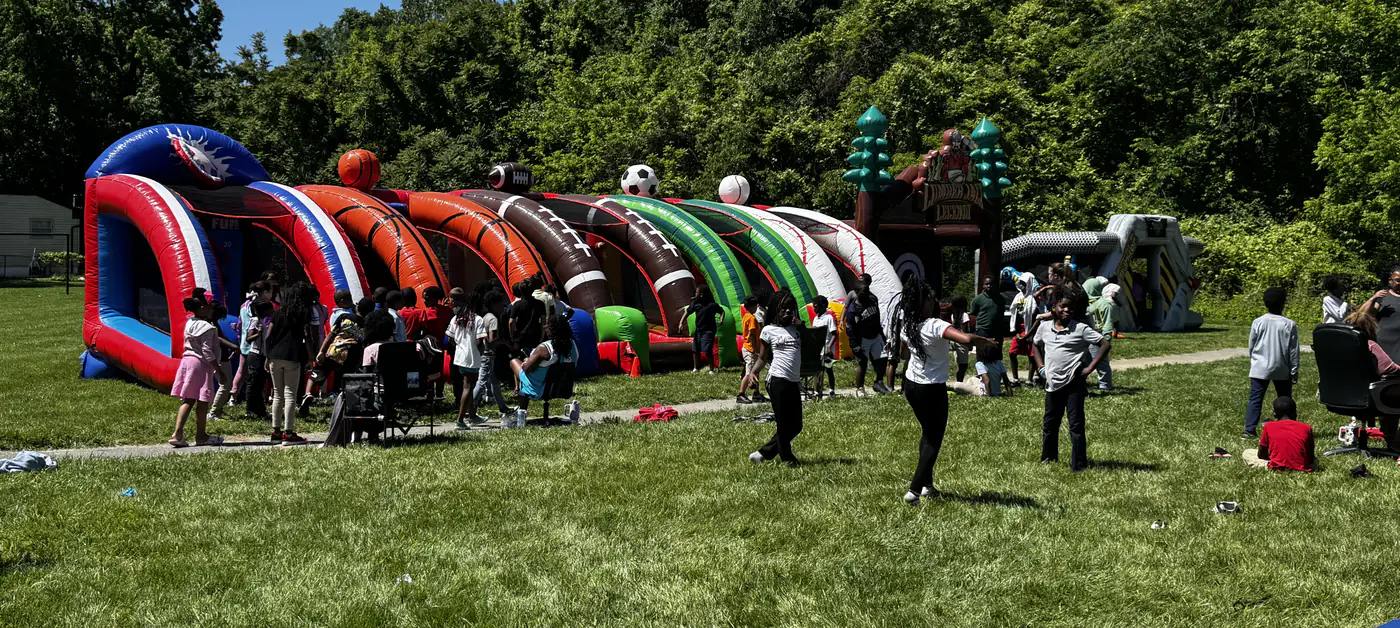
- Inflatables. Bounce houses, obstacle courses, and sport games, delivered and anchored, from $200 per unit. The under-8 crowd lives here, and it is why their parents get twenty unbroken minutes.
- Virtual reality. Four Meta Quest 3 headsets, hosted the whole time, $300 per hour, and it fits in a classroom or a corner of the gym.
- Game arena. A pop-up console lounge on big screens at $300 per hour, the right answer when your carnival lives indoors.
- RC racing. A custom track for up to 16 racers at $300 per hour, good for a gym floor or a flat stretch where an inflatable will not fit.
"We rented ME 2 YOU GAME TRUCK for our school and we were extremely impressed." That's Jennifer Bitzer. If your carnival runs a full day instead of an evening, our School Specials bundles start at $3,500 on weekdays and cover up to four hours with the truck, laser tag, an obstacle course, and sport inflatables in one price, staffed start to finish.
Tickets, wristbands, and the fundraiser question
Three ways schools price a carnival, and each changes the night:
- Per-ticket. Kids buy a strip and spend tickets booth by booth. It raises the most per family, and it also puts a volunteer at every station handling paper instead of running the game.
- Wristband. One price, unlimited play, sold in advance and at the door. It removes the ticket handling, gets you a headcount before the night, and lets every station run wide open. Most schools that switch stay switched.
- Free entry with food and prizes sold. The right call when the carnival's job is turnout, and the one that draws the families a fundraiser quietly prices out.
Whichever you pick, sell in advance. Pre-sales tell you how many kids to plan for, which tells you how many stations you need. And put your fixed costs on paper before you set the price.
The paperwork your office will ask for
Districts want three documents from any outside vendor, and getting them late is what turns a booked carnival into a stressful one. Ask for a certificate of insurance naming the district, a W-9, and a purchase order estimate before your business office has to chase anybody.
We send the W-9 right away, request your COI from our insurer the moment you book, and return a PO estimate the same or next day. Schools pay no deposit, and payment is by check with no fee or credit card with a 3% fee. Our hosts are background-checked, which is worth putting in the email to your principal even when nobody asks.
Gym, blacktop, and the weather call
Late October in St. Louis will hand you a cold drizzle roughly one year in three, so decide in September which parts of the carnival move indoors and which do not run at all. Draw both maps and send both to your station leads.
Three things worth checking on the walk-through. The game truck parks outside in any weather and is heated inside, so it tends to be the last thing still going on a cold night. Laser tag needs grass, so a rained-out field means moving it into the gym or dropping it. Inflatables come indoors when the ceiling allows, so measure your gym height before you promise a slide. Then name the person making the call, pick a call time, and say where it gets posted.
A six-week timeline
Google's keyword volume data for the United States shows searches for fall carnival ideas near 880 a month in September and 720 in October, against 10 to 30 in winter. That curve is also the booking curve, which is why schools that call in August get their first-choice date.
- 6 weeks out. Lock the date and the rain plan, and book any hosted attraction the same week. October dates go first and they go early.
- 5 weeks out. Decide tickets or wristbands, set the price, and open sign-ups by station and shift rather than by a general call for help.
- 4 weeks out. Send vendor paperwork to your business office, and start prize and donation asks, because local businesses need lead time.
- 3 weeks out. Promote it three ways: a flyer home in backpacks, the school newsletter, and the parent group page. Each reaches different families.
- 2 weeks out. Walk the space and draw the map, including where a truck or trailer parks and how it gets back out.
- 1 week out. Close pre-sales, confirm every shift by name, and send the map and arrival windows to vendors and station leads.
- Day of. Volunteers arrive 45 minutes early, attractions 60 to 90 minutes early, and one person owns check-in.
What the carnival chair gets back
The person running a school carnival almost never gets to see it. They spend the two hours refilling a prize table, covering a shift somebody dropped, and hunting for an extension cord. Every station you hand to a hosted vendor is a shift you do not have to fill.
We bring the attraction, a named host who runs it start to finish, and the paperwork your office would otherwise chase. You get to walk your own carnival and talk to the families who came, which is why you took the job.